How Buddhist Manuscripts Moved Across Asia
How Buddhist manuscripts moved across Asia depended on routes, translators, and local choices; see how texts changed as communities carried and copied them.
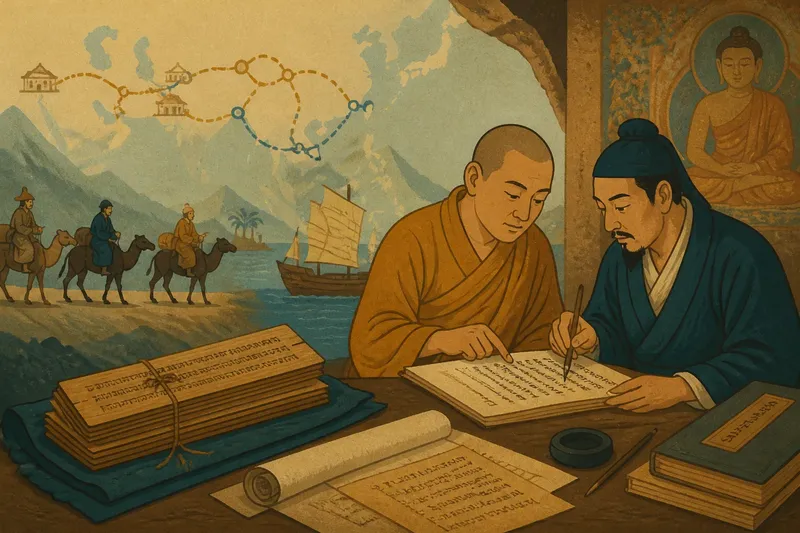
A palm-leaf manuscript could be read aloud in one monastery, copied by a scribe, and carried onward by a traveler. How Buddhist manuscripts moved across Asia depended on many such encounters, not one continuous journey along a single road.
The surviving evidence points to varied practices across different communities and periods. Oral teaching, written copies, and communal recitation could overlap, but no single pattern describes every early Buddhist tradition.
How were Buddhist teachings preserved before manuscripts traveled?
In early Buddhist communities, oral transmission was one important way to preserve and teach material. Monastics learned passages by recitation, and group recitation could help maintain shared versions. The details varied across communities; writing materials, literacy, and local customs were not uniform.
Written collections later provided another means of preservation, but they did not simply replace oral practice. A passage could be recited, copied, and recited again. Manuscripts remained connected to teachers and communities who interpreted and used them.
“Manuscript” covers different physical forms. In South Asia, Buddhist texts were written on materials such as palm leaves and birch bark. Leaves could be arranged in a bundle and held together with a cord. Copying and carrying such texts required materials and care suited to local conditions.
Communities did not all transmit identical collections. Texts circulated in different languages and lineages, while teachers and local readers made choices about what to teach or copy. Those choices influenced which versions remained available.
Which routes carried Buddhist texts across Asia?
Overland routes linked South Asia with Central Asian settlements and Chinese cities. Traders, pilgrims, monks, translators, and envoys used overlapping paths through regions that now include parts of Afghanistan, Pakistan, and Central Asia. Towns and monasteries along the way could serve as places to rest, study, and exchange teachings.
“The Silk Road” is a convenient name for connected routes, not one fixed track across a map. Travel depended on local roads, political conditions, and caravan centers. A manuscript might pass through several people and communities, without any one traveler completing the entire journey.
Sea routes also connected Buddhist communities. Ships carried people and goods through ports around the Bay of Bengal and across the eastern Indian Ocean toward Sri Lanka and Southeast Asia. The relative importance of land and sea connections differed by region and period.
Books traveled as part of broader exchanges. Travelers also carried ritual practices, stories, images, and linguistic knowledge. A community might encounter Buddhist teachings through a visiting teacher or a translated passage as well as through a manuscript.
What changed when Buddhist texts entered new languages?
Translation meant more than substituting one word for another. A Buddhist term might lack a direct equivalent in the receiving language. Translators could borrow its sound, select a local word, or explain the idea with a phrase.
In Chinese translation, imported terms and familiar Chinese words could both be considered. A familiar word might help readers approach an idea, yet carry associations that did not fit the source. Translators had to weigh clarity against preserving distinctions in the teaching.
Translation could involve collaboration. A person familiar with the source language might explain a passage aloud, while a local specialist helped render it into Chinese. Scribes and editors could then revise the wording. The exact process differed from one translation setting to another.
Imagine a translator and a Chinese-speaking collaborator working on a passage whose central term has no close local equivalent. They try a familiar philosophical word, then notice that it suggests an idea the passage rejects. They keep a transliterated term and add an explanation; readers can then encounter the unfamiliar word alongside guidance about its meaning.
How did local communities adapt the texts they received?
Translation was only one part of reception. Communities chose which works to copy, teach, and place beside other writings. A collection in one region could differ from one in another because teachers valued different material or had access to different manuscripts.
Readers also interpreted Buddhist teachings through local intellectual traditions and concerns. This was not simply a matter of losing an original meaning. Communities engaged with imported ideas, and their questions shaped how those ideas were explained.
Books themselves could reflect local practice. Scribes used available materials and scripts, divided long works into sections, or added notes. Such decisions affected how readers handled and understood a text, even when its wording stayed close to an earlier version.
A translation could become a source for another translation. A text rendered into Chinese might later be translated into a different language, carrying traces of both the earlier source and the Chinese wording. Each stage could preserve material while also introducing new interpretive choices.
Why did Central Asian communities matter to manuscript circulation?
Central Asia was more than a passage between South Asia and China. Its communities had patrons, languages, monasteries, and artistic traditions of their own. Kucha and Khotan, for example, were centers where Buddhist teachers and texts circulated within regional settings.
People in the region used languages beyond Sanskrit and Chinese, including Tocharian and Sogdian. A surviving manuscript fragment might be a translation, a copy of a translated work, or a text used by a community connected to wider networks. Its language alone cannot establish where it was written.
Local copying and teaching helped keep texts available to readers farther along the routes. Some surviving fragments preserve material that is poorly represented elsewhere. Their presence reveals a history of regional use, not merely a handoff from an origin to a destination.
Art and architecture provide further context for these exchanges. Buddhist images and painted cave spaces in Central Asia show religious ideas taking form in regional styles. They belonged to the same settings where texts were read, explained, and supported.
What can a manuscript tell you about its route?
Does a text’s language show where it was written?
Not by itself. Language may point to a translation tradition or a community that used the text, while the surviving copy could have been made elsewhere.
Did every Buddhist region share the same scriptures?
No single collection represented every Buddhist community across Asia. Traditions organized and preserved texts differently, and access to particular works varied.
Can a translation preserve a teaching while changing its wording?
Yes. A translator might borrow a term, choose a local phrase, or explain a difficult idea. The wording changes as the translator works to communicate the teaching in another language.
Why are manuscript fragments useful?
A fragment can reveal a script, language, copying practice, or textual version. Its limits matter: a small surviving piece rarely records the whole history of a work.
How can you trace a text without assuming a straight route?
Separate a text’s source, translation, surviving copy, and later reception. They are related but distinct. A work may originate in one language, be translated in another region, copied elsewhere, and interpreted by communities farther along.
Then ask what the object itself can show. Its material, script, language, and condition offer clues, but no one feature establishes every stage of its journey. Historians compare these details with other texts and evidence about the setting in which a manuscript was used.
Imagine a reader examining a fragment with Chinese writing but no reliable record of where it was found. The reader notes its script and wording, compares those features with known translations, and treats the result as a clue rather than proof of a specific route. The likely conclusion is limited: the fragment belongs to a Chinese-language textual tradition, while its precise place of copying remains unresolved.
Missing links are part of this history. Many manuscripts have been lost, and a surviving copy may be much later than the work it preserves. Accounts of how Buddhist manuscripts moved across Asia are strongest when they distinguish documented connections from plausible ones. That care leaves room for the people who carried, copied, translated, and taught texts without assigning them a journey the evidence cannot establish.