The Samurai Were Never One Unchanging Type
Samurai across Japanese history held changing roles. Learn how period, political setting, and source type clarify whether a record shows military service or office.
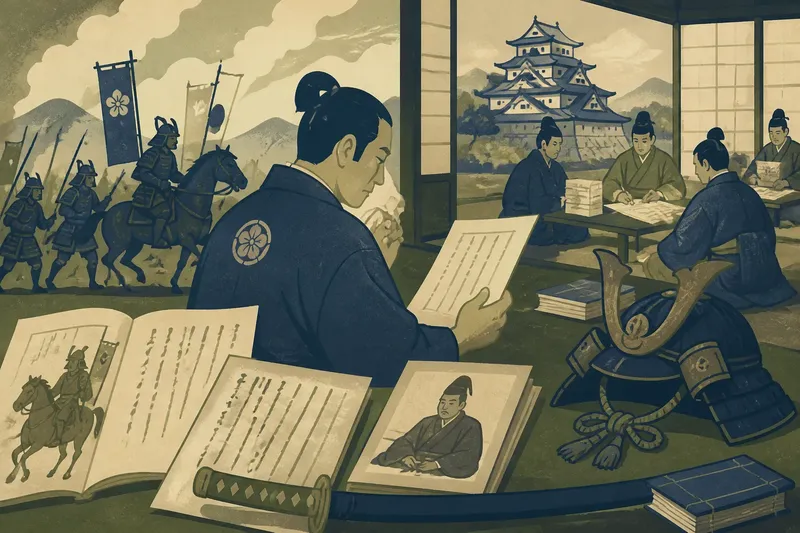
A museum display places a curved sword beside a helmet, and the label says “samurai.” That familiar pairing can hide more than it explains. Samurai across Japanese history held different duties and positions, shaped by the period and political setting in which they lived. To understand a particular person, begin with when and where he lived, then ask what his role required.
This approach helps when comparing a document, family story, painting, or popular drama. Each source may present a different aspect of samurai life. Those differences do not necessarily mean that one account is false; they may reflect changes in the institutions that shaped samurai status and service.
What did “samurai” mean in its setting?
The term did not describe one job that stayed the same. It came to be associated with armed service and political status, but the balance between those features shifted over time. Some samurai served as mounted warriors or retainers; others held administrative, policing, or domain-management duties. In times of conflict, military service could be immediate. During periods of relative peace, office work and household responsibilities could take up more of a person’s daily life.
It also helps to distinguish samurai from “warrior” as a broad description. A person could fight without belonging to the samurai status group, while a samurai might spend much of his working life away from a battlefield. A modern translation may flatten these distinctions, so check what the original context says about service, rank, and obligation.
Follow the source’s emphasis. A record concerned with stipends, appointments, or official duties presents samurai as members of a governing order. A battle account foregrounds military action. Neither view alone describes every person called samurai.
How did samurai roles vary by period?
Period is a useful starting point because political arrangements shaped the duties expected of samurai. In earlier eras, court authority and local military service overlapped in ways that do not map neatly onto later images of a warrior class. As military governments gained influence, service relationships and ranks were formalized in different ways.
Under the Tokugawa shogunate, which ruled during a long era of relative internal peace, samurai roles varied by domain, rank, and appointment. Some served in administrative offices, while military duties and preparations remained part of the wider political order. This was not a single, uniform shift from fighting to administration: local conditions and individual positions continued to matter.
For a source from an era of civil conflict, consider how military service and shifting alliances shape its account. For a Tokugawa-period source, look at offices, domain administration, household rank, and the constraints of peace. These are broad distinctions, not a script for every person.
Imagine a reader comparing a military chronicle with a household record from a peaceful domain. The chronicle describes a retainer riding out under a lord’s command; the household record lists an official post and a family stipend. The reader can treat both as accounts of samurai life while recognizing that they describe different responsibilities, rather than making either source represent the whole group.
Was a samurai a fighter, an official, or both?
Use documented duties rather than the familiar sword-bearing image. Samurai could have military responsibilities and carry out civil work. Some served in roles involving record keeping, supervision, local order, or domain administration. Military capacity remained part of the status ideal, but it did not define every workday.
Look for verbs and institutional clues. Does the source describe someone leading troops, guarding a place, collecting information, issuing orders, or managing accounts? Does it name a lord, domain, or official post? Such details help distinguish a person’s role from a visual symbol. A sword in a portrait may signal status or self-presentation; by itself, it does not establish what the subject did for a living.
An administrative account is not evidence that its subject was somehow less of a samurai. It may show how political authority depended on retainers who could govern as well as fight. Conversely, a military account reflects the demands of its setting without proving that all samurai were active combatants.
How should you read samurai ideals and images?
Statements about loyalty, discipline, courage, and self-control tell you which values a source promotes or remembers. They are not a complete description of how every samurai behaved. Ideals can guide conduct, justify a social order, or make a past age seem coherent to later audiences. The gap between an ideal and daily practice is itself useful evidence.
Be careful with the idea of a single, fixed “bushido,” often translated as “the way of the warrior.” The term is sometimes presented as though it named a timeless rulebook for samurai of every period. Ideas about warrior conduct, however, were expressed and reshaped in different settings. Ask who presents an ideal, when it was written or depicted, and what behavior it praises.
Visual images need the same care. Armor, swords, and formal poses can communicate rank, memory, or aspiration. A later portrait may show how a person or family wished to be remembered, rather than offer a neutral view of daily work. Compare the image with its captions, related documents, and circumstances of production before drawing conclusions.
Which questions help you read a samurai source?
Does the source describe a battlefield or a peacetime office?
Identify the setting before deciding what the source says about samurai generally. A battle narrative highlights service under military pressure, while an administrative record can reveal work that sustained political rule between conflicts.
Who created the source, and for whom?
A family portrait, official record, and dramatic story have different purposes. Consider whether the maker aimed to document duties, affirm status, preserve a memory, or entertain an audience.
Is the source contemporary with the person it depicts?
A later account may preserve meaningful traditions while also reshaping the past. Separate what it says about its own period from what it claims about an earlier one.
Does the source show a whole group or a single case?
One person’s career can clarify a particular role, but it cannot stand for every samurai. Look for other sources from the same period and setting before making a broader claim.
What can you check when accounts disagree?
Compare the sources’ period, region, and social position before treating them as contradictory. Two accounts may differ because one describes a warrior during conflict and the other an official in a settled domain. If their settings match, consider each source’s purpose and audience. A family history may praise service and loyalty, while an administrative document records duties without trying to celebrate them.
- Check whether both sources name the same period; if they do not, describe the difference as a change over time, then compare their contexts rather than combining their claims.
- Check whether both refer to the same region or domain; if they do, compare local institutions, and if they do not, keep regional differences explicit.
- Check whether the person’s status is stated; if it is, distinguish that recorded status from the person’s actual behavior, and if it is not, avoid assigning status from clothing or weapons alone.
- Check the source’s purpose and audience; if it praises a family or leader, treat its ideals as part of its message, and if it records routine duties, use it to describe those duties without assuming it explains every value.
- Check whether the account was made during the person’s lifetime; if it was, compare its claims with other contemporary records, and if it was made later, separate evidence about the later memory from claims about the earlier period.
- Check whether a claim rests on one person’s experience; if it does, describe it as an individual case, and if several comparable sources support it, state the pattern with its period and setting attached.
Then separate claims about status from claims about behavior. A record may show that someone held a samurai position; it may not prove how closely he followed an ideal. A story praising courage reveals what its audience was invited to admire, but does not establish that the scene represents routine experience.
Keep uncertainty visible. If the sources support several readings, state what each makes clear and what remains unresolved. That is more accurate than smoothing differences into a single, confident portrait.
How can you describe samurai without making them timeless?
Name the period and role whenever the evidence allows. “A domain official with samurai status” is more informative than “a samurai” when a source concerns governance. “A retainer serving in a military campaign” gives the reader a clearer sense of setting than a generalized claim about warrior life.
The phrase “samurai across Japanese history” points toward a better question than “What were samurai like?” Ask which people were called samurai in a given setting, what duties they performed, and how later representations changed their image. The answer may include fighters, administrators, household members, and figures shaped by memory, without treating those roles as interchangeable.
When you encounter a sword or a dramatic tale, use it as a starting clue, not a complete definition. A period, a place, and a documented responsibility can turn the familiar samurai image into a more precise account of how Japanese society changed.