What to Notice at a Japanese Tea Gathering
What to notice at a Japanese tea gathering: follow gestures, setting, and objects to understand the occasion while recognizing that customs vary.
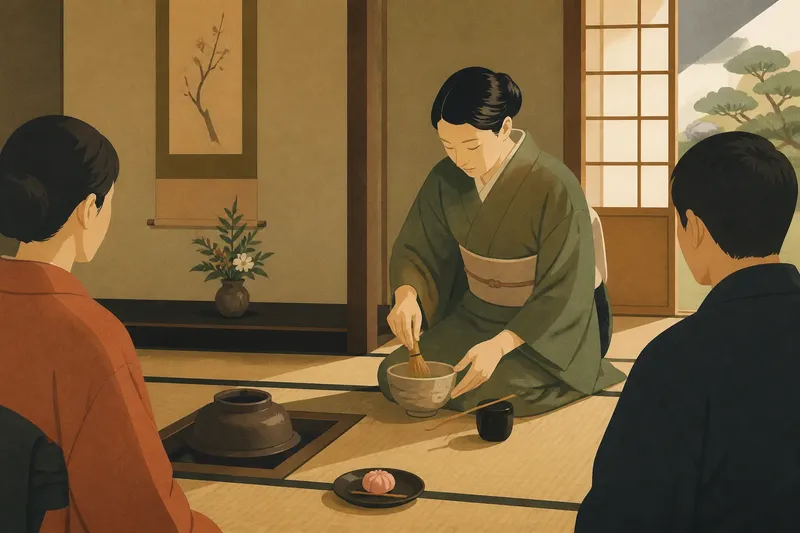
You enter a quiet room, pause at its threshold, and see a bowl being turned before tea is offered. At a Japanese tea gathering, small gestures can carry meaning, but their order and emphasis vary with the host, school, season, and occasion. A first-time viewer can follow three things: how people move through the setting, how objects are handled, and how the gathering’s pace changes.
What kind of gathering are you watching?
Japanese tea practice is often called chanoyu or chadō. These terms refer to traditions of preparing and sharing tea, but they do not describe one uniform script. A formal gathering may include a meal and several stages of hospitality; a shorter presentation may focus on preparing a bowl of matcha. Some events are designed for guests to observe, while others expect participants to take part.
Before you arrive, check whether the host has given guidance about clothing, seating, photography, or guest participation. If you are unsure, ask the organizer before the event or quietly follow the host’s directions once there. Different tea schools and venues have their own customs, so a gesture you see in one room should not be treated as a universal rule.
As a viewer, distinguish the visible action from an interpretation of it. You can notice that a host cleans a tea utensil, for example, without deciding that the movement has exactly the same meaning in every setting. Attention is useful; certainty about a single hidden meaning is not.
Should you follow the room or the objects?
Two approaches help make a first visit legible. The first is to follow the room: notice where the host and guests sit, how attention shifts, and when a person enters or leaves the working area. This suits viewers who want to understand the social shape of the gathering. The second is to follow the objects: observe what the host brings forward, handles, or sets aside. This suits viewers drawn to material culture and craft.
You do not have to choose only one. Start with the room, since it shows who is acting and where the action is directed. Then select one or two objects to watch closely. Trying to track every gesture and utensil at once can make the sequence harder to follow.
Imagine you are seated with a clear view of the host’s hands but not the full alcove. You notice a tea bowl arrive, the host prepare the tea, and the bowl pass to a guest. By tracking that bowl rather than guessing at every movement, you can see how an object links preparation and hospitality, even if you miss details elsewhere.
What does the setting tell you?
Look first at the room’s arrangement. A tea gathering may take place in a dedicated tea room, a larger interior, or another space adapted for the occasion. The threshold, seating, and path between host and guests shape what can be seen and how people approach one another. In some settings, guests enter by a low doorway; in others, the room is reached more ordinarily. Avoid assuming that one architectural feature defines every gathering.
The alcove, often called a tokonoma, may hold a hanging scroll, a flower arrangement, or another seasonal display. Notice what is present and how it relates to the room, rather than trying to decode it as a fixed symbol. A scroll’s calligraphy or a simple arrangement may set a tone for the occasion, but the specific choice depends on context and the host’s intention.
Light and sound also guide attention. A quiet room may make the movement of a kettle, the placement of a bowl, or a short exchange easy to notice. In a larger public demonstration, the host may turn or lift objects so viewers can see them. Treat these differences as features of the particular event, not evidence that one format is more authentic.
Which objects are worth watching?
A tea gathering may bring several utensils into view. Matcha is powdered green tea, commonly prepared in a bowl with hot water and a bamboo whisk called a chasen. The host may use a tea scoop, or chashaku, to transfer the powder. A tea caddy can hold the tea, while a kettle and brazier or hearth provide the setting for hot water. Not every object will be visible at every event.
The bowl deserves particular attention because it is used, presented, and received. Notice how the host holds it, where it rests, and whether a guest turns it before drinking. The turn-and-drink sequence is taught in some schools of Japanese tea practice, including forms associated with Urasenke, as a way to avoid drinking from the bowl’s marked front. It is not a universal rule across tea schools or occasions. If you are participating, follow the host’s instruction rather than copying a gesture you saw in a different setting.
There may also be a container or dish for sweets. A sweet can be served before the tea, but timing and form depend on the occasion. Observe how the host offers it and how guests respond. The point is not to memorize a list of objects; it is to see how each item enters the shared space and then leaves it.
What questions help you read the sequence?
Why does the host clean a utensil?
Cleaning movements can prepare an object for use and make the act of preparation visible to guests. Their exact form and emphasis vary, so watch the sequence and setting rather than assigning one universal explanation.
Why might a guest turn the tea bowl?
In some schools, including Urasenke, guests are taught to turn the bowl before drinking so the marked front is not directly against the lips. The expected gesture can differ by school or occasion, so a participant should follow local guidance.
What should I do if I miss a gesture?
Stay attentive and continue watching; there is no need to reconstruct every movement. If you are taking part and are uncertain about what to do next, wait for the host or an experienced guest to guide you.
May I take photographs?
Do not assume photography is welcome, even in a public demonstration. Ask the organizer in advance, and keep your attention on the gathering if photographs are not invited.
How do you choose what to focus on?
Choose according to your seat and the event’s format. If you have a view of the entrance and guests, follow how people move and how the room changes as the gathering proceeds. If your view is centered on the host’s hands, follow the bowl, whisk, and tea caddy. If the host explains the objects aloud, listen for the names and relationships offered rather than trying to identify everything from appearance alone.
For a first visit, notice the opening arrangement, follow one object through its use, and then watch how the host and guests share the prepared tea. You can adapt this approach to a formal gathering or a brief demonstration without treating either as a complete model of Japanese tea practice.
What to notice at a Japanese tea gathering is not a secret code but a set of visible relationships: a room directs attention, objects pass between hands, and gestures shape an occasion. Leave space for variation. The most respectful observation begins with what you can actually see and lets the host’s own explanation supply the context you cannot.